

Introduction
The APJ Abdul Kalam biography is one of the most inspiring life stories in modern India. Born in a small coastal town in Tamil Nadu, Avul Pakir Jainulabdeen Abdul Kalam rose from a modest home to become one of India’s greatest scientists and then the President of India. He is remembered as the Missile Man of India and as the People’s President, two titles that capture both his scientific achievement and his warmth towards ordinary people, especially students.
Kalam’s life connects several chapters of India’s history. He worked on India’s first satellite launch vehicle, led the development of indigenous missiles, played a central role in the Pokhran-II nuclear tests of 1998, and then moved to Rashtrapati Bhavan as the 11th President of India from 2002 to 2007. After his presidency he returned to teaching and writing, and he died while doing what he loved most, delivering a lecture to students at IIM Shillong on 27 July 2015.
This APJ Abdul Kalam biography covers his early life, education, scientific career, presidency, books, awards and legacy in full, with the dates and facts that matter, so that students and general readers can understand not only what he achieved but how he achieved it.
APJ Abdul Kalam Biography: Quick Facts
| Fact | Detail |
| Full name | Avul Pakir Jainulabdeen Abdul Kalam |
| Born | 15 October 1931, Rameswaram, Tamil Nadu |
| Died | 27 July 2015, Shillong, Meghalaya (aged 83) |
| Parents | Jainulabdeen Marakayar (father), Ashiamma (mother) |
| Education | St Joseph’s College, Tiruchirappalli; Madras Institute of Technology |
| Career | DRDO scientist, ISRO project director, President of India |
| President of India | 25 July 2002 to 25 July 2007 (11th President) |
| Known as | Missile Man of India, People’s President |
| Famous books | Wings of Fire, India 2020, Ignited Minds |
| Top honours | Padma Bhushan (1981), Padma Vibhushan (1990), Bharat Ratna (1997) |
Early Life in Rameswaram
APJ Abdul Kalam was born on 15 October 1931 in Rameswaram, a temple town on Pamban Island in Tamil Nadu. His father, Jainulabdeen Marakayar, was a boat owner and imam of a local mosque. His mother, Ashiamma, was a homemaker. The family had once been wealthy but had lost much of its fortune by the time Kalam was born, and money was often tight in the household.
Kalam was the youngest of five children. His childhood home was a small house on Mosque Street in Rameswaram. Despite the limited means, his parents gave him a strong foundation of honesty, discipline and faith. His father taught him that prayer and hard work must go together, and his mother taught him kindness and compassion for others. These values stayed with Kalam for the rest of his life and shaped the way he led teams and treated people.
His teachers noticed his interest in science and mathematics. One of his teachers, Siva Subramania Iyer, encouraged him to dream big and told him that he could achieve anything if he worked hard. Kalam often recalled this teacher with gratitude. Another influence was his cousin Samsuddin, who ran a newspaper agency and helped Kalam earn money by distributing newspapers. These early experiences in Rameswaram gave Kalam a rare combination of humility and ambition.
Education and the Dream of Flying
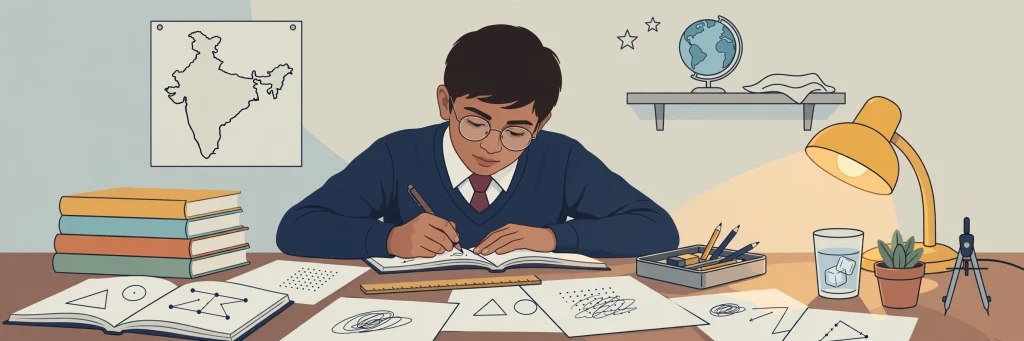
Kalam studied at the Schwartz Higher Secondary School in Ramanathapuram and then at St Joseph’s College in Tiruchirappalli, where he graduated in physics in 1954. He then decided to study aeronautical engineering, a field that was still new in India. He joined the Madras Institute of Technology, where he studied aerospace engineering and graduated in 1960.
At the Madras Institute of Technology, Kalam was a dedicated but not always top-ranking student. He once recalled that a professor was unhappy with his progress on a project and gave him three days to finish it, warning him that his scholarship would be cancelled if he failed. Kalam worked day and night and completed the project on time. The experience taught him that hard work under pressure can produce results that seem impossible at first.
Kalam had dreamed of becoming a fighter pilot. He applied to the Indian Air Force and reached the interview stage, but he was ranked ninth when only eight candidates were selected. He was deeply disappointed, and he later described this as one of the great setbacks of his life. He travelled to Rishikesh to reflect, and he came away with a new understanding that sometimes a closed door leads to a better path. Instead of flying aircraft, he went on to design the rockets and missiles that would defend the country.
Joining DRDO and the First Steps in Science
Kalam joined the Defence Research and Development Organisation, known as DRDO, in 1958, where he worked on a hovercraft project for the Indian Army. This was his first job as a scientist, and it gave him practical experience in designing and building new technology. He learned how to work in a team, how to test ideas in the real world, and how to keep going when an experiment failed.
In 1962, he joined the Indian National Committee for Space Research, which later became the Indian Space Research Organisation, known as ISRO. He worked under the guidance of Dr Vikram Sarabhai, the father of the Indian space programme. Sarabhai recognised Kalam’s talent and gave him responsibility and freedom to learn. Kalam often said that Sarabhai taught him the importance of vision and of building institutions that outlast individuals.
During this period, Kalam also trained at the NASA Langley Research Center in the United States and at other centres. He studied rocket technology and returned to India with new knowledge and a clear goal: to help India build its own satellite launch capability rather than depending on other countries.
The SLV-III Project and India’s First Satellite Launch
In 1969, Kalam moved to ISRO and became the project director of the Satellite Launch Vehicle, known as SLV-III. This was India’s first satellite launch vehicle designed and produced in the country. The project was a major challenge because India had limited resources and little experience in this field, and many experts doubted that it could be done.
Kalam led a team of young scientists and engineers who worked for years on the SLV-III. The first launch attempt in August 1979 failed, and the satellite fell into the Bay of Bengal. Kalam was deeply upset, but ISRO chairman Satish Dhawan took responsibility for the failure in public and gave the team confidence to try again. The next launch, on 18 July 1980, was a success. The SLV-III placed the Rohini RS-1 satellite into orbit near the Earth, and India became a member of the small group of countries that could launch their own satellites.
The Missile Man of India
Kalam rejoined DRDO in 1982 and took charge of the Integrated Guided Missile Development Programme, known as IGMDP. The programme aimed to develop indigenous missiles so that India would not have to depend on imports for its defence. Under his leadership, India developed several successful missiles, including Agni, an intermediate range ballistic missile first launched in 1989, and Prithvi, a tactical surface to surface missile.
The title Missile Man of India came from this work. Kalam did not work alone, and he always gave credit to his teams, but his role as the leader who planned the programme, solved technical problems and kept the mission on track was widely recognised. The Agni and Prithvi missiles became the backbone of India’s missile capability, and the programme also built a generation of Indian scientists and engineers who went on to lead other defence and space projects.
Pokhran-II and the Nuclear Tests of 1998
In 1998, Kalam played a central role in the Pokhran-II nuclear tests, India’s second series of nuclear tests after the first test in 1974. As the Scientific Adviser to the Defence Minister and later the Principal Scientific Adviser to the Government of India, he was one of the chief coordinators of the tests, working with other scientific teams. Five devices were detonated at Pokhran in Rajasthan in May 1998.
The tests were a major moment in India’s history and in Kalam’s life. They demonstrated India’s nuclear capability to the world and led to international sanctions and intense debate. Supporters saw the tests as a necessary step for national security, while critics raised concerns about the arms race and the cost. Kalam himself believed that strength in science and technology was essential for India to be taken seriously and to protect its interests.
After Pokhran-II, Kalam became a national figure. He was known not only as a scientist but as a person who had helped to change India’s position in the world. His calm and humble manner in public made him popular across political divides, and this popularity later helped him become President.
President of India: The People’s President
On 25 July 2002, Kalam was sworn in as the 11th President of India, after winning the presidential election with a large majority. He was supported by the ruling coalition and by several opposition parties, a rare show of consensus. He succeeded K. R. Narayanan and served until 25 July 2007.
Kalam was called the People’s President because he made Rashtrapati Bhavan open and approachable. He met thousands of students, answered their letters, and visited schools and colleges across the country. He believed that the President should be a teacher and a guide to the young, and he used the office to talk about education, science and national development rather than only about ceremony.
Kalam decided not to seek a second term as President. He left office on 25 July 2007 and was succeeded by Pratibha Patil. He said that he wanted to return to teaching and writing, and he did exactly that, spending the next eight years travelling to schools, colleges and universities across India and abroad.
Books That Inspired a Generation
Kalam was a prolific writer, and his books have been read by millions of people in India and around the world. His autobiography, Wings of Fire, written with Arun Tiwari and published in 1999, tells the story of his life from Rameswaram to the presidency. It is one of the most popular books by an Indian author and is often recommended to students.
India 2020, published in 1998, set out his vision for a developed India. Ignited Minds, published in 2002, is a collection of his ideas about unlocking the power within India. Other books include My Journey, Turning Points, and Transcendence, which describes his spiritual experiences. His writing is simple and direct, and it always returns to the same themes: dream big, work hard, serve the country and never give up.
Awards and Honours
Kalam received many awards during his life, both from the Government of India and from the international community. He was awarded the Padma Bhushan in 1981, the Padma Vibhushan in 1990, and the Bharat Ratna in 1997, India’s highest civilian honour. He was one of the few people to receive all three Padma awards and the Bharat Ratna.
He also received honorary doctorates from many universities, including the University of Edinburgh and the University of Waterloo. In 2013, he was awarded the Von Karman Wings Award by the California Institute of Technology. Several institutions, roads and schemes have been named after him, including the APJ Abdul Kalam Technological University in Kerala and the Kalam Memorial in Rameswaram.
Final Years, Death and Legacy
After leaving the presidency, Kalam continued to teach and to meet students. He was a visiting professor at the Indian Institute of Management Shillong, the Indian Institute of Management Ahmedabad and other institutions. He travelled constantly, often speaking to young people about science, education and the future of India.
On 27 July 2015, while delivering a lecture at the Indian Institute of Management Shillong, Kalam collapsed and died of an apparent cardiac arrest. He was 83 years old. His death shocked the country, and tributes poured in from leaders, scientists, teachers and students. He was buried with full state honours in Rameswaram, his hometown.
For students in India, the APJ Abdul Kalam biography is more than a history lesson. It is a guide to how to live. Kalam’s own advice was simple: dream is not what you see in sleep, it is the thing that does not let you sleep. He lived by that advice, and his life continues to inspire young Indians to dream big and to work for the country.
Frequently Asked Questions
When was APJ Abdul Kalam born?
APJ Abdul Kalam was born on 15 October 1931 in Rameswaram, Tamil Nadu, India. He was the youngest of five children in a modest Muslim family.
What is APJ Abdul Kalam famous for?
APJ Abdul Kalam is famous as the Missile Man of India for his work on the SLV-III satellite launch vehicle and the Agni and Prithvi missiles, and as the People’s President for his term as the 11th President of India from 2002 to 2007.
When did APJ Abdul Kalam become President of India?
APJ Abdul Kalam became President of India on 25 July 2002 and served until 25 July 2007. He was the 11th President of India.
What are the famous books of APJ Abdul Kalam?
The famous books of APJ Abdul Kalam include Wings of Fire, his autobiography, India 2020, Ignited Minds, My Journey and Turning Points. Wings of Fire is his most widely read book.
How did APJ Abdul Kalam die?
APJ Abdul Kalam died on 27 July 2015 after collapsing while delivering a lecture at the Indian Institute of Management Shillong. He died of an apparent cardiac arrest at the age of 83.
What awards did APJ Abdul Kalam receive?
APJ Abdul Kalam received the Padma Bhushan in 1981, the Padma Vibhushan in 1990 and the Bharat Ratna in 1997, India’s highest civilian honour. He also received many honorary doctorates and international awards.
Conclusion
The APJ Abdul Kalam biography is a story of a boy from Rameswaram who became a scientist, a leader and a President, and who never lost his humility or his love for students. From distributing newspapers as a child to leading India’s missile programme, from the failure of the first SLV launch to the success of Rohini, from Pokhran-II to Rashtrapati Bhavan, Kalam’s life shows what is possible when talent meets hard work and integrity.
His legacy is not only in the rockets and missiles he helped to build, but in the millions of young Indians he inspired to dream, to study and to serve the country. As long as students read Wings of Fire and remember his words, the APJ Abdul Kalam biography will continue to guide new generations in India and around the world.
