

Valmiki Jayanti 2026 is celebrated today, Monday, 26 October, on Ashwin Shukla Purnima, the full moon day of the Hindu month of Ashwin. Also known as Pargat Diwas or Pragat Diwas, it marks the birth anniversary of Maharishi Valmiki, the sage traditionally credited with composing the Ramayana and honoured as the Adi Kavi, the first poet of Sanskrit literature.
Many readers search for this date every year because it moves with the lunar calendar, and because it often falls close to Sharad Purnima, which causes confusion. This guide clears up that confusion, gives the exact tithi timings for 2026, retells Valmiki’s life in plain language, explains the Ramayana in a way first time readers can follow, and sets out how the day is celebrated across India, so you can observe it meaningfully today or plan a visit, a reading or a family discussion around it.
Valmiki Jayanti sits in the heart of India’s festive season. Diwali 2026, the festival of lights, is covered in our guide here.
Valmiki Jayanti 2026 date and tithi timings
- Festival: Valmiki Jayanti, also called Maharishi Valmiki Jayanti and Valmiki Pargat Diwas
- Date in 2026: Monday, 26 October 2026
- Hindu calendar day: Ashwin Shukla Purnima, the full moon of Ashwin
- Purnima tithi begins: 25 October 2026, 11:55 AM IST
- Purnima tithi ends: 26 October 2026, 9:41 AM IST
- Why the date is 26 October: the festival follows the lunar day convention that assigns the observance to 26 October, even though the tithi begins on 25 October.
That last point explains the most common question each year: is Valmiki Jayanti on 25 or 26 October? For 2026, the answer used by Drik Panchang and the Rashtriya Panchanga is Monday, 26 October. Timings can vary slightly by city and by Panchang calculation, so if you are planning a puja at a specific temple, confirm the local timing with that temple. For general observance, prayers, readings and processions on 26 October are the norm.
Why Valmiki Jayanti is not the same as Sharad Purnima
Sharad Purnima and Valmiki Jayanti share the same full moon season, and in 2026 they fall on neighbouring days, which is why they are often mixed up. Sharad Purnima was observed on 25 October in the festival calendar checked for this guide, while Valmiki Jayanti is listed on 26 October. They are different observances: Sharad Purnima centres on the moon, the kheer kept under moonlight, and Lakshmi worship in many regions, while Valmiki Jayanti centres on the birth anniversary of Maharishi Valmiki and on the Ramayana.
If you followed Sharad Purnima yesterday, today is a natural continuation, not a repeat. Our Sharad Purnima guide, with moonrise timings and the kheer ritual, is here.
Who was Maharishi Valmiki
Maharishi Valmiki is known as the Adi Kavi, the first poet, because tradition credits him with composing the first Sanskrit epic in verse form. Before he became a sage, tradition tells a powerful story of transformation. Valmiki, then known as Ratnakara, lived as a robber who supported his family by looting travellers. When sages he stopped told him to ask his family whether they would share the sin of his deeds, his family refused, saying they would share his earnings but not his sins. That answer changed his life.
According to tradition, Valmiki then sat in deep meditation for so long that an anthill, called Valmika in Sanskrit, grew around him, and from that he took the name Valmiki. The story is told not as history in the modern sense, but as a moral teaching that runs through his work: no past is so fixed that a person cannot change direction, and responsibility for one’s actions cannot be passed to others.
Later, Valmiki’s ashram became a place of shelter and learning. Tradition holds that Sita found refuge there, and that her twin sons, Lava and Kusha, were born and raised in his ashram, where they learned the Ramayana itself and later sang it. That detail links Valmiki not only to the author of the epic, but to its first performers and teachers.
The Ramayana in plain language
The Valmiki Ramayana is traditionally described as containing about 24,000 verses, or shlokas, arranged in seven Kandas, or books. It tells the life of Rama, prince of Ayodhya, his exile, the abduction of Sita by Ravana, the search for Sita, the battle in Lanka, and the return to Ayodhya.
- Bala Kanda: Rama’s birth, childhood and marriage to Sita
- Ayodhya Kanda: the exile, and the questions of duty, promise and family loyalty
- Aranya Kanda: life in the forest, and Sita’s abduction
- Kishkindha Kanda: Rama’s alliance with Sugriva and Hanuman, and the search
- Sundara Kanda: Hanuman’s leap to Lanka, and the message of hope to Sita
- Yuddha Kanda: the battle in Lanka, and the rescue of Sita
- Uttara Kanda: the later events after the return to Ayodhya
For a modern reader, the Ramayana is useful on two levels. As literature, it is a masterclass in character, dialogue and moral dilemma: Rama’s duty versus personal happiness, Sita’s courage and dignity, Lakshmana’s loyalty, Hanuman’s devotion and resourcefulness, and Ravana’s brilliance undone by pride. As a cultural text, it has shaped Indian theatre, dance, music, television, temple art and everyday language for centuries. You do not need to read all 24,000 verses to benefit from it: a single Kanda, a good retelling, or even one well told episode discussed as a family can be a fitting Valmiki Jayanti observance.
How Valmiki Jayanti is celebrated in India
Celebrations vary by region, but the core elements are consistent: prayer, reading, procession and community service.
- Temple visits: devotees visit temples dedicated to Maharishi Valmiki, offer prayers and flowers, and join bhajan and kirtan sessions. Valmiki Mandir on Mandir Marg in Delhi is among the best known.
- Ramayana recitation: families and temples recite passages from the Ramayana, sometimes over the full day, sometimes a single chosen episode.
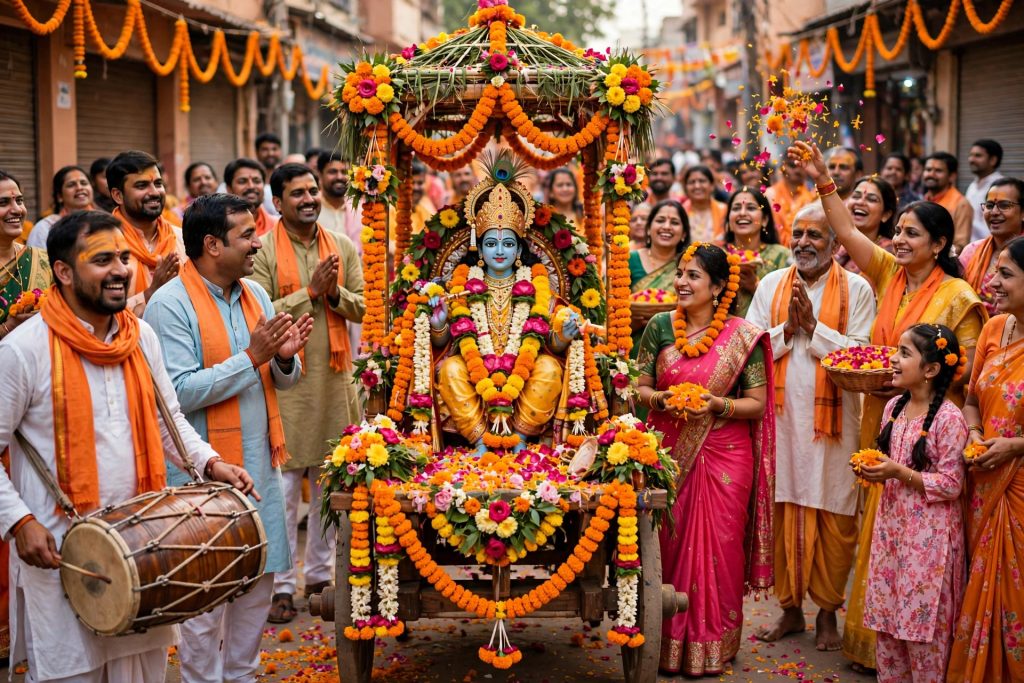
- Shobha Yatras: decorated processions with tableaux, music and devotional singing move through towns and neighbourhoods, often in the afternoon or evening.
- Community service: many organisers pair the celebration with food distribution, cleanliness drives and help for the poor, reflecting Valmiki’s teachings on compassion and dignity.
- Cultural programmes: schools and cultural groups stage plays, songs and talks on Valmiki’s life and the Ramayana’s values, which makes the day accessible to children.
Leaders across India’s political spectrum routinely issue tributes on Valmiki Jayanti, saluting his teachings on dignity, justice, sacrifice and duty. That cross party observance reflects how widely the Ramayana’s moral vocabulary is shared in Indian public life.
A simple Valmiki Jayanti plan for today
If you want to observe the day at home, without a temple visit, this simple plan works for families and for individuals.
- Morning: light a diya, offer flowers, and read or listen to one episode from the Ramayana, such as Hanuman’s leap to Lanka or Rama’s return to Ayodhya.
- Midday: discuss one question as a family: what does duty mean when it costs us personally? That single question captures the heart of the epic.
- Afternoon or evening: join a local Shobha Yatra or cultural programme if one is happening near you, or watch a good Ramayana retelling together.
- Throughout the day: practise one concrete act of service, such as feeding someone, helping a neighbour, or cleaning a shared space, in the spirit of the day’s teachings.
For children, the transformation story of Ratnakara becoming Valmiki is the most powerful entry point. It teaches that change is possible, that actions have consequences, and that learning and patience can remake a life. That is a lesson that needs no religious background to appreciate.
Valmiki Jayanti and the festivals that follow
Valmiki Jayanti is not the end of the festive season, it is a pause for reflection inside it. The next major observance for many families is Chhath Puja, the four day festival dedicated to the Sun God, with Sandhya Arghya on Sunday, 15 November 2026. Our complete planning guide is here.
Reading the Ramayana during this period, even in small daily portions, is a tradition many families keep from Valmiki Jayanti through Diwali and beyond. It turns a single day’s celebration into a season of reading and reflection.
Frequently Asked Questions
When is Valmiki Jayanti in 2026?
Valmiki Jayanti 2026 is on Monday, 26 October 2026, on Ashwin Shukla Purnima.
What are the Valmiki Jayanti 2026 tithi timings?
Purnima tithi begins at 11:55 AM IST on 25 October 2026 and ends at 9:41 AM IST on 26 October 2026. Timings may vary slightly by city.
Who was Maharishi Valmiki?
Maharishi Valmiki is the sage traditionally credited with composing the Ramayana, and honoured as the Adi Kavi, the first poet of Sanskrit literature.
How many verses are in the Valmiki Ramayana?
The Valmiki Ramayana traditionally contains about 24,000 verses in seven Kandas.
How is Valmiki Jayanti celebrated?
Devotees visit Valmiki temples, recite the Ramayana, join Shobha Yatras, sing bhajans, and take part in community service and cultural programmes.
Is Valmiki Jayanti the same as Sharad Purnima?
No. They fall close together in 2026, but Sharad Purnima was observed on 25 October, while Valmiki Jayanti is on 26 October, and they honour different things.
Conclusion
Valmiki Jayanti 2026, on Monday, 26 October, is a day to honour a poet, a sage and a story that has shaped India for millennia. The date and tithi are easy to confirm, but the real observance is in the reading, the reflection and the service that follow. Valmiki’s own transformation, from Ratnakara to Adi Kavi, reminds readers that change is always possible, and the Ramayana’s lessons on duty, dignity, compassion and justice remain as practical today as they were when they were first sung. Whether you visit a temple, join a Shobha Yatra, read a single episode, or simply discuss one moral question at home, you are keeping alive the tradition this day celebrates.
