

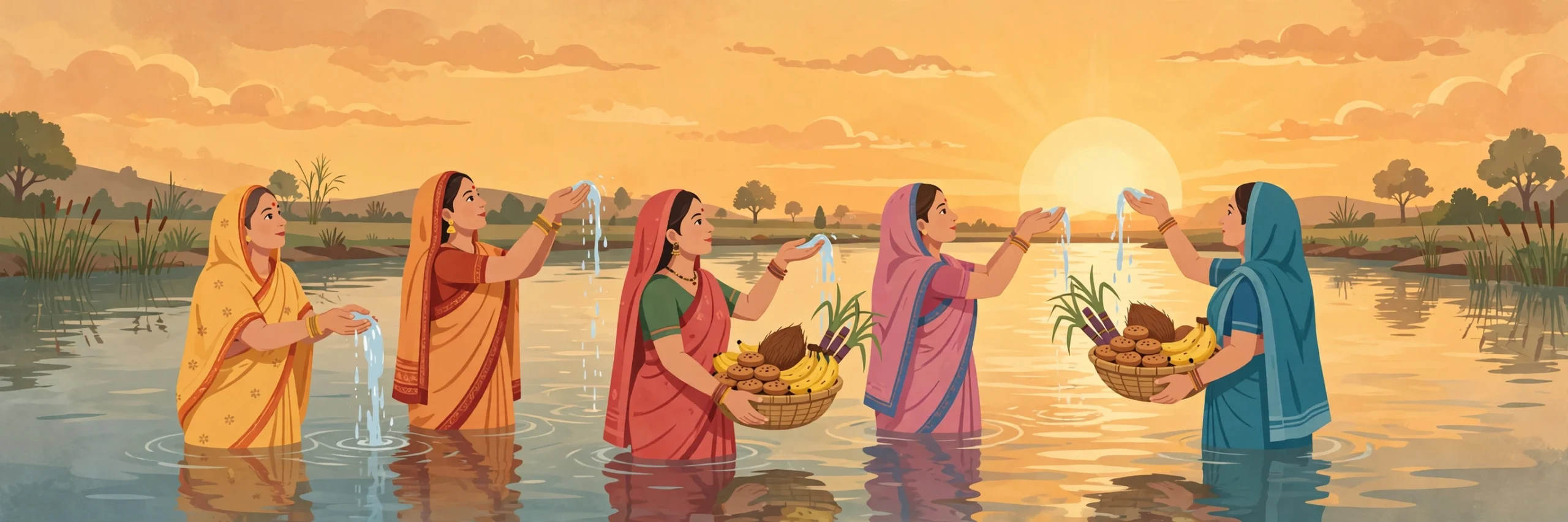
Chhath Puja 2026 will be observed from Friday, 13 November to Monday, 16 November, with the main Sandhya Arghya falling on Sunday, 15 November. It is one of the most disciplined and visually striking festivals in India, dedicated to Surya, the Sun God, and Chhathi Maiya. Unlike most festivals, it has no idol and no priest at its centre. The devotee, called the vrati, stands in a river or pond and offers arghya directly to the setting sun and then to the rising sun.
The festival is most fervently observed in Bihar, Jharkhand, eastern Uttar Pradesh and Nepal, and it is now celebrated by large diaspora communities in Delhi, Mumbai, Kolkata and cities abroad. Because the main evening falls on a Sunday this year, most working people can join the Sandhya Arghya without taking leave, and the Friday to Monday sequence forms a natural long weekend. This guide brings together the verified dates, city-wise arghya timings, day-by-day rituals, the prasad checklist, travel planning and health guidance, so that first-timers and regular observers alike can plan with confidence.
Chhath follows Diwali in the festive calendar. Diwali 2026 falls on Sunday, 8 November, exactly one week before Sandhya Arghya, which makes the whole fortnight a continuous season of homecoming, cleaning, cooking and gathering. Read our Diwali guide here:
Chhath Puja 2026 dates at a glance
The festival follows a fixed four-day structure. Each day has a name, a ritual purpose and a place in the fast.
- Day 1, Nahay Khay, Friday, 13 November: the holy bath, cleaning of the home, and one simple sattvic meal, usually lauki with rice and chana dal.
- Day 2, Kharna, Saturday, 14 November: a day-long fast, broken after sunset with rasiao kheer and roti. After this meal, the 36-hour nirjala fast begins.
- Day 3, Sandhya Arghya, Sunday, 15 November: the main day. Arghya is offered to the setting sun, standing in water at the ghat.
- Day 4, Usha Arghya, Monday, 16 November: arghya is offered to the rising sun, and the fast is broken. This is called parana.
The dates follow the Kartik Shukla Shashthi tithi. Panchami ends late on Saturday, 14 November, and Shashthi covers sunset on Sunday, 15 November across India, which is why the evening arghya falls on Sunday.
City-wise arghya timings for Chhath Puja 2026
Arghya is offered at the actual sunset and sunrise in your own city, never at another city’s time. Reach the ghat 30 to 60 minutes early, because crowds, barricades and closed roads around major ghats can slow you down, and the sun can disappear behind trees or buildings a minute or two before the published time.
- Patna: Sandhya Arghya sunset 5:01 PM on 15 November, Usha Arghya sunrise 6:07 AM on 16 November.
- Delhi: Sandhya Arghya sunset 5:28 PM on 15 November, Usha Arghya sunrise 6:44 AM on 16 November.
- Ranchi: Sandhya Arghya sunset 5:04 PM on 15 November, Usha Arghya sunrise 6:03 AM on 16 November.
- Varanasi: Sandhya Arghya sunset 5:10 PM on 15 November, Usha Arghya sunrise 6:16 AM on 16 November.
- Mumbai: Sandhya Arghya sunset 6:00 PM on 15 November, Usha Arghya sunrise 6:46 AM on 16 November.
- Kolkata: Sandhya Arghya sunset 4:53 PM on 15 November, Usha Arghya sunrise 5:50 AM on 16 November.
Families living abroad should use their own local sunset and sunrise on the same four dates, and follow the guidance of their local samiti or temple where local calendars differ.
Day-by-day rituals of Chhath Puja
Nahay Khay begins with purity. The vrati bathes, traditionally in a river, and the house and kitchen are cleaned. Only one meal is eaten, cooked without onion or garlic and usually with rock salt instead of ordinary salt. Family members eat after the vrati.
Kharna is a full day of fasting. After sunset, worship is offered and the prasad of rasiao kheer, rice cooked in milk with jaggery, and roti is eaten first by the vrati in quiet, then shared with family and neighbours. The thekua, the signature Chhath prasad, is often prepared on this evening. Once the Kharna meal is over, the vrati takes neither food nor water for about 36 hours.
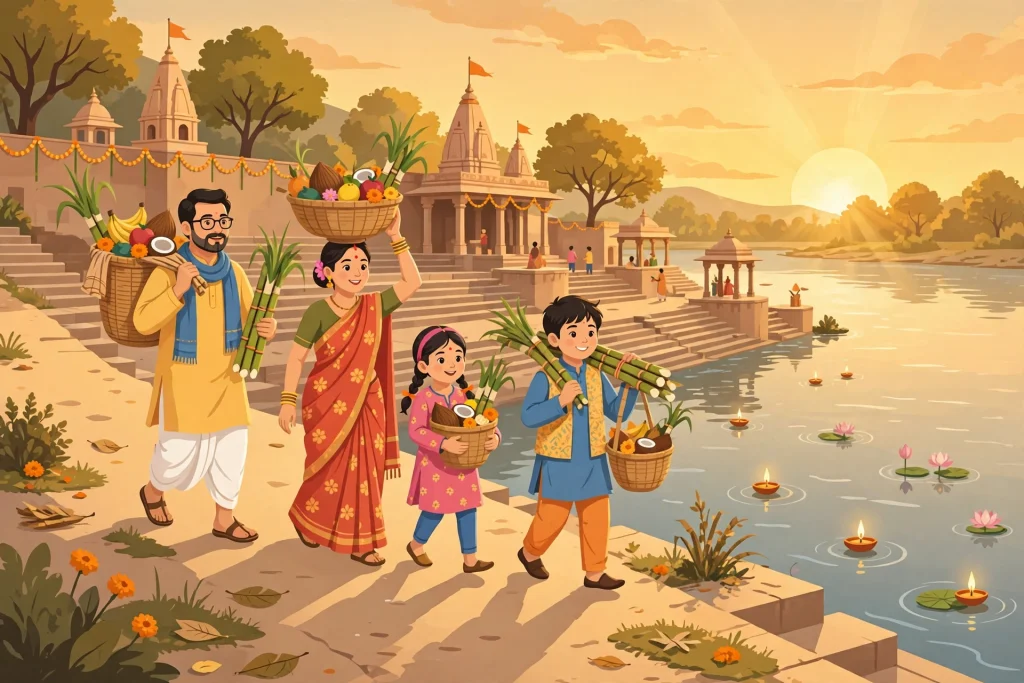
Sandhya Arghya is the heart of the festival. In the late afternoon, the family walks to the ghat, the daura often carried on the head, singing Chhath geet. Standing waist-deep in the water, the vrati raises the soop filled with thekua, fruits and sugarcane and offers arghya to the setting sun. Many families then observe kosi at night, with lamps lit under a canopy of sugarcane stalks.
Usha Arghya closes the festival. Before sunrise, the family returns to the ghat. Arghya is offered to the rising sun, Chhathi Maiya is prayed to, and the vrati breaks the fast with water and a little prasad. The prasad is then shared with everyone present.
Samagri list and thekua recipe
The essentials are the soop, the daura, thekua, fruit, a lamp and water or milk for the arghya. A practical checklist helps, because most items are bought new each year.
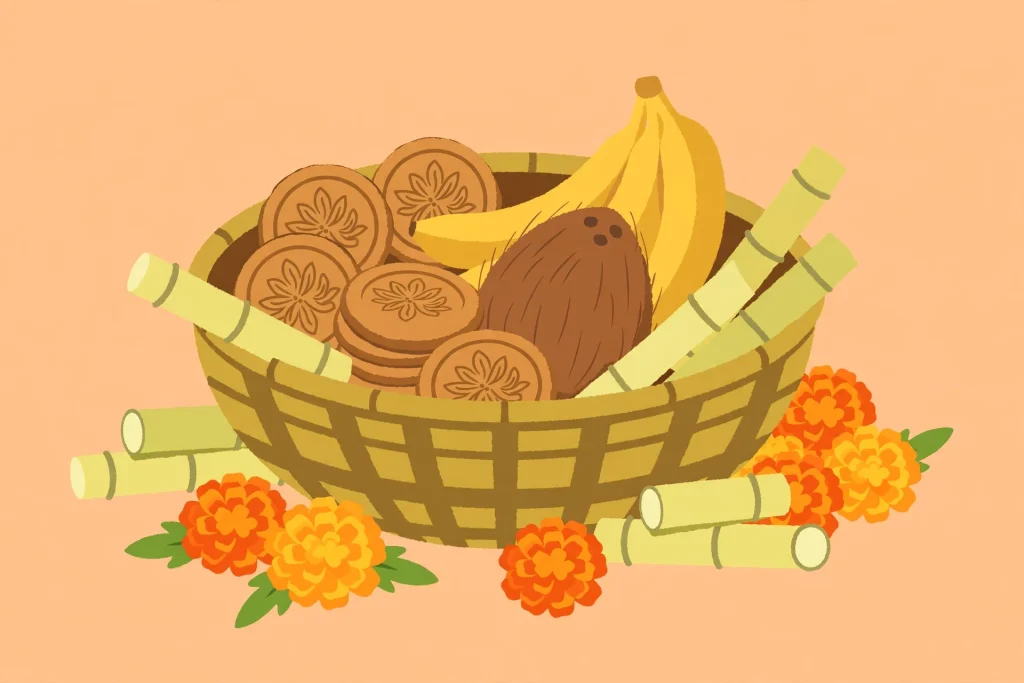
- Soop, the bamboo winnowing basket on which the prasad is raised during the arghya, and daura, the deep bamboo basket that carries everything to the ghat.
- Thekua, made from wheat flour, jaggery and ghee, shaped in a wooden mould and deep-fried.
- Kasar or rice laddoo, made from roasted rice flour and jaggery.
- Sugarcane with leaves, a bunch of bananas, coconut, sweet lime, water chestnut, sweet potato and seasonal fruit.
- Fresh turmeric and ginger plants with leaves, diya with ghee and cotton wicks, a lota or kalash, sindoor, flowers, betel leaf and incense.
- Rice, milk, jaggery and wheat flour for the Kharna prasad, plus new or freshly washed clothes for the vrati.
For thekua, mix wheat flour with melted jaggery, a little ghee and cardamom, knead into a stiff dough, press portions into a thekua mould or shape them by hand, and deep-fry on a low flame until crisp and golden. The vrati usually prepares the prasad and does not taste it while cooking, and the prasad is cooked separately from ordinary food.
Planning your Chhath: ghats and travel
Chhath is the second largest homecoming migration in India after Diwali. People travel from Delhi, Mumbai and Kolkata back to Bihar, Jharkhand and eastern Uttar Pradesh, so the busiest corridors are Delhi to Patna, Delhi to Gorakhpur and Delhi to Varanasi. Book outbound tickets at least two to three weeks before 13 November, and book the return leg at the same time, because the return surge peaks on Tuesday, 17 November and Wednesday, 18 November.
In Patna, the heart of Chhath, the Ganga riverfront has dozens of ghats, including Gandhi Ghat, Digha Ghat and Collectorate Ghat, with lighting, medical camps and crowd barriers set up by the administration. Accommodation in Patna during Chhath week fills early, so book at least three weeks in advance or plan to stay with family.
In Delhi NCR, Chhath is a public holiday, and the Yamuna ghats near ITO and Kalindi Kunj are the primary locations, with temporary ghats announced across Noida, Gurugram and other NCR areas one to two weeks before the festival. Metro services on lines serving the ghat areas usually run extended hours on the Sandhya Arghya evening and the Usha Arghya morning.
In Varanasi, Assi Ghat and Dashashwamedh Ghat host Chhath celebrations alongside the city’s regular evening aarti, and the city also leads into Dev Deepawali a few days later.
Ghat safety and crowd tips
Ghats are crowded, wet and dark at dawn, so a few practical habits matter more than any timetable. Wear footwear with grip for wet steps, keep children close and never let them enter deep water alone, and carry a torch for the early morning return. Keep the ghat clean, follow the barricades and the instructions of volunteers and police, and avoid carrying valuables into the water. If you are visiting a ghat for the first time, go with a family that knows the local arrangement, and stake your place in the afternoon rather than arriving at sunset.
Health note for the 36-hour nirjala fast
Going about 36 hours without food or water, and standing in cold water at dusk and dawn, puts real strain on the body. The tradition itself allows care: a modified fast, joining the arghya without fasting, or another family member keeping the vrat on your behalf are all common and respected options. Speak to your doctor before keeping the nirjala fast if you are pregnant or breastfeeding, if you have diabetes, heart, kidney or liver disease, low blood pressure, or a history of fainting, or if you take regular medication that cannot be skipped. Children and teenagers can help and join the arghya, but they should not keep a waterless fast. Stop the fast and get medical help if the vrati feels faint, confused or very weak, has chest pain or palpitations, stops passing urine, or shivers uncontrollably after leaving the water. In India, call 112 in an emergency.
Staying healthy through the festive season is easier with small, steady habits. Our guide to simple home fitness routines for busy people is here:
Celebrating Chhath away from home
Many readers now celebrate Chhath far from their family ghat. If you live in a flat, you can still keep the core of the festival: prepare the prasad at home, join a community ghat organised by a local samiti, and offer arghya at a clean pond, lake or temporary waterbody arranged for the festival. If you live abroad, use your local sunset and sunrise, buy soops and dauras from an Indian grocer in advance, and confirm the date with your local temple, because a few diaspora calendars differ by a day. The heart of Chhath is devotion, discipline and gratitude to the sun, and that travels with the family wherever it is kept.
Frequently Asked Questions
When is Chhath Puja in 2026?
Chhath Puja 2026 runs from Friday, 13 November to Monday, 16 November, with the main Sandhya Arghya on Sunday, 15 November and Usha Arghya on Monday, 16 November.
What time is Sandhya Arghya in Patna and Delhi?
In Patna, sunset on 15 November is at about 5:01 PM. In Delhi, sunset on 15 November is at about 5:28 PM. Always confirm with your local panchang, because times vary by a few minutes by city.
How long is the nirjala fast during Chhath?
The waterless fast begins after the Kharna meal at dusk on Saturday, 14 November and ends after the Usha Arghya at sunrise on Monday, 16 November, roughly 36 hours.
What is thekua?
Thekua is the signature Chhath prasad, made from wheat flour, jaggery and ghee, shaped in a wooden mould and deep-fried. It is carried to the ghat in the soop along with fruits and sugarcane.
Is Chhath Puja a public holiday in Delhi?
Yes, Chhath Puja is a gazetted public holiday in Delhi, and temporary ghats are set up across the city for the diaspora celebration.
Can I celebrate Chhath if I cannot keep the fast?
Yes. You can join the arghya without fasting, keep a modified fast with your doctor’s advice, or have another family member keep the vrat on your behalf. Participation and devotion matter more than hardship.
Conclusion
Chhath Puja 2026 gives families a rare combination: a festival that is ancient, public and deeply personal at the same time. With the main evening falling on a Sunday, this year is an especially good one for first-timers to join, for children to watch and learn, and for families living away from home to plan their travel early. Mark the four dates, confirm your city’s arghya time, prepare the prasad with care, and reach the ghat early. If you plan the travel, the food and the fast with the same discipline the festival itself teaches, Chhath becomes not just a ritual to complete but a memory the whole family carries into the year ahead. For more on the world of science and discovery that shapes our times, see our latest roundup here:

6 Comments
Pingback: Major Technology Conferences to Watch in 2026 - Joge Baba
Pingback: Beparwah Movie: Ahaan Panday, Sharvari First Look and 26 March 2027 Release
Pingback: Valmiki Jayanti 2026: Date, Timings and Significance
Pingback: Winter Skin Care Routine for India: Dry Skin Guide That Actually Works
Pingback: Karwa Chauth 2026: Date, Moonrise Time, Puja Muhurat and Rituals Guide
Pingback: November 2026 Festivals and Holidays in India: Complete Calendar and Dates