

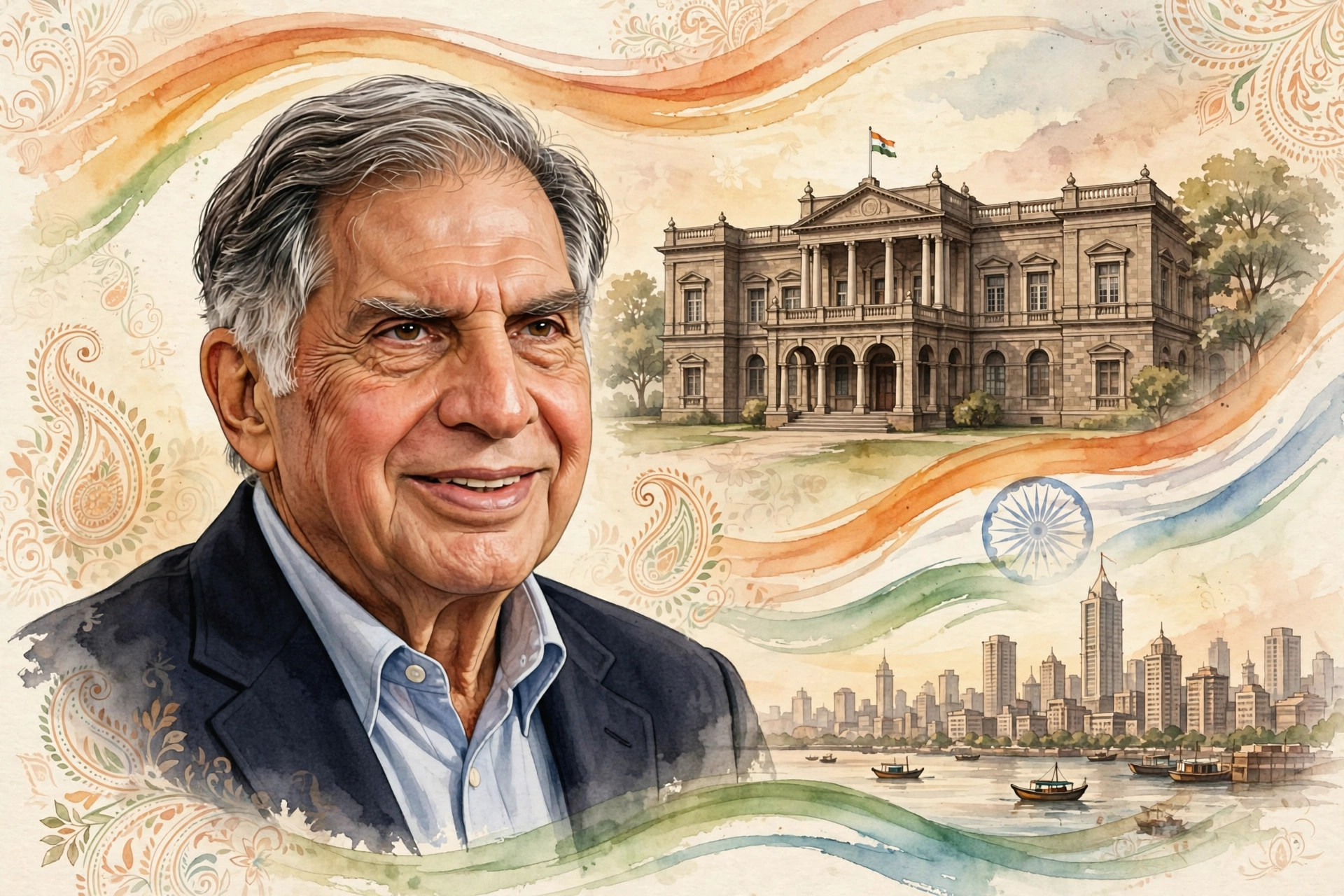
Few business leaders have commanded the affection that Ratan Tata enjoyed across India. When he passed away on 9 October 2024 at the age of 86, the tributes came not only from boardrooms but from shopkeepers, students and strangers who felt they had lost a personal mentor. This biography traces his life, his transformative leadership of the Tata Group, his philanthropy and the values that made him a national icon.
Early Life and Education
Ratan Naval Tata was born on 28 December 1937 in Mumbai into one of India’s most prominent industrial families. His parents separated when he was young, and he was raised largely by his grandmother, Lady Navajbai Tata, whose influence he often credited for his humility and sense of duty. He studied architecture at Cornell University in the United States and later completed the Advanced Management Program at Harvard Business School, an international education that shaped the global outlook he would later bring to Indian industry.
Starting at the Bottom: Learning the Business
Despite his famous surname, Ratan Tata began his Tata career in 1961 on the shop floor of Tata Steel, shovelling limestone and working alongside furnace operators in Jamshedpur. Colleagues from those years remembered a young man who asked questions, listened carefully and refused special treatment. The experience gave him a ground-level understanding of the workers whose lives the group’s decisions affected, a perspective that stayed with him for the next six decades.
Chairman of Tata Sons: The Transformative Years
In 1991, J.R.D. Tata named Ratan Tata his successor as chairman of Tata Sons. The timing could hardly have been more dramatic: India had just opened its economy, and the group’s sprawling collection of companies faced foreign competition for the first time. Many doubted the quiet, soft-spoken successor. Over the next two decades he proved them wrong, streamlining the group, exiting underperforming businesses and focusing capital on industries where Tata could genuinely lead.
Read More: Global Economic Changes That Could Affect Consumers in 2026
Taking Tata Global: Tetley, Corus and Jaguar Land Rover
Ratan Tata’s boldest moves were international. In 2000, Tata Tea acquired the British brand Tetley, then one of the largest overseas acquisitions ever made by an Indian company. In 2007, Tata Steel won a dramatic bidding war for the Anglo-Dutch steelmaker Corus. And in 2008, Tata Motors acquired Jaguar Land Rover from Ford, a purchase many analysts called overpriced at the time, but which later became one of the group’s crown jewels under patient, hands-off ownership that respected the brands’ British engineering heritage.
Read More: AI Regulation Updates Every Business Should Watch This Year
The Tata Nano: A Car for Every Indian Family
Few projects reflected his empathy more than the Tata Nano. The idea came to him after watching a family of four precariously balanced on a scooter in Mumbai traffic. Launched in 2008 at a headline price of one lakh rupees, the Nano was an engineering marvel of frugal innovation. Although it never became the commercial success he had hoped for, it cemented his reputation as a leader who thought about ordinary Indians first.
Philanthropy: Giving Away Most of a Fortune
True to the Tata tradition established by founder Jamsetji Tata, Ratan Tata channelled the bulk of his wealth into charitable trusts. Roughly two-thirds of the holding company Tata Sons is owned by philanthropic trusts that fund education, healthcare and rural development across India. Personally, he supported causes ranging from cancer research to stray-animal welfare, and he was known for quietly helping individuals who wrote to him: students needing fees, patients needing treatment.
Read More: US Political Developments Putting Key Policy Decisions in Focus
Awards, Honours and Public Life
India honoured him with the Padma Bhushan in 2000 and the Padma Vibhushan in 2008, the country’s second-highest civilian award. He received honorary doctorates and state honours around the world, yet remained famously accessible, answering emails personally, flying his own plane and living modestly by billionaire standards. His public statements on ethics in business became reference points for an entire generation of Indian entrepreneurs.
Leadership Lessons from Ratan Tata
Three principles defined his leadership style. First, lead with values: he repeatedly said he would rather lose business than compromise on ethics. Second, take bold, long-term bets: the Corus and Jaguar Land Rover acquisitions were criticised in the short term and vindicated over time. Third, treat people with dignity: from factory floors to boardrooms, he listened more than he spoke, and employees across the group described a chairman who remembered names and noticed effort.
The Final Years and an Enduring Legacy
He stepped down as chairman in December 2012 and served as chairman emeritus, remaining a moral compass for Indian industry. In his final years he became an enthusiastic backer of young Indian start-ups, investing in dozens of them and mentoring founders personally. When he died in October 2024, India mourned not just an industrialist but a standard of integrity, proof that scale and decency can coexist in business.
Frequently Asked Questions
Who was Ratan Tata?
Ratan Tata (1937–2024) was an Indian industrialist and philanthropist who served as chairman of Tata Sons, the holding company of the Tata Group, from 1991 to 2012. He transformed the group into a global conglomerate and was widely admired for his ethics and philanthropy.
When did Ratan Tata become chairman of Tata Sons?
He became chairman in 1991, succeeding J.R.D. Tata, and led the group until December 2012, a tenure of over two decades that included landmark acquisitions such as Tetley, Corus and Jaguar Land Rover.
What were Ratan Tata’s biggest achievements?
His defining achievements include taking the Tata Group global through major international acquisitions, launching the Tata Nano people’s car, and expanding the group’s philanthropic footprint through the Tata Trusts, which fund education and healthcare across India.
How did Ratan Tata die?
Ratan Tata passed away on 9 October 2024 in Mumbai at the age of 86. The Maharashtra government declared a day of state mourning, and he was accorded a state funeral.
Conclusion
Ratan Tata’s life offers a rare lesson: that ambition need not come at the cost of kindness. He built a global business empire, gave most of it away, and earned something money cannot buy, the genuine love of a nation. For readers in India and beyond, his biography remains a blueprint for leadership grounded in integrity.

2 Comments
Pingback: MS Dhoni Biography: Early Life, Career, Records and Family (2026)
Pingback: How to Grow on Instagram in India in 2026: Reels, Reach and Strategy