
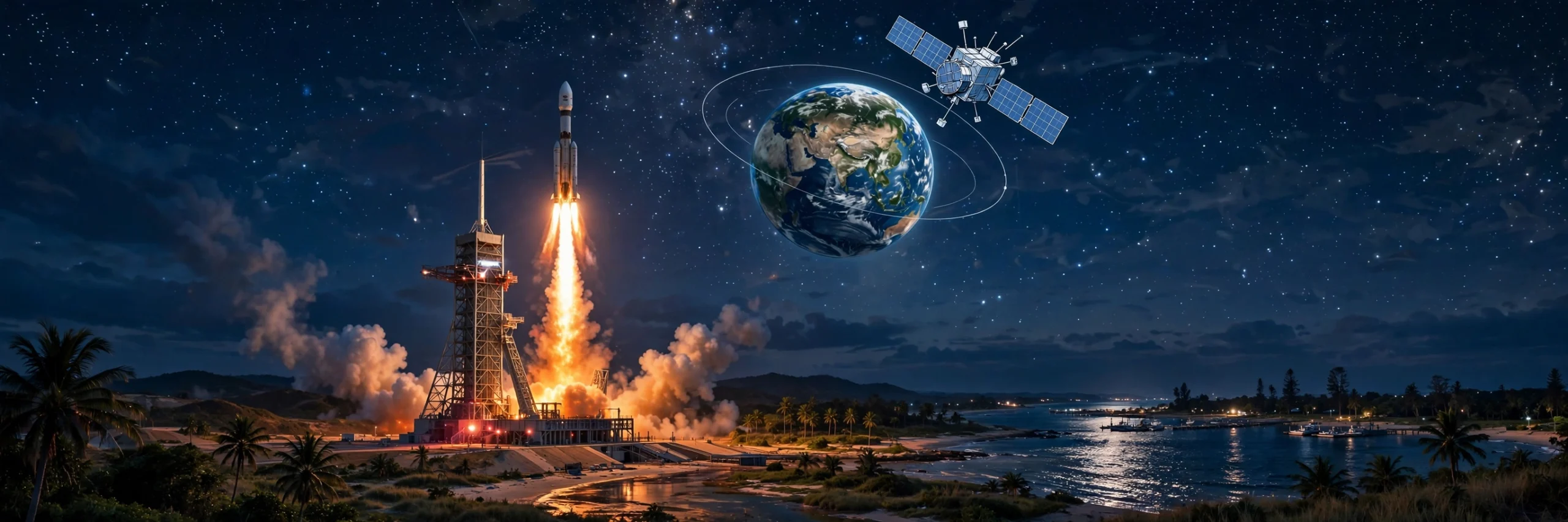
India is set to strengthen its own satellite navigation system on the night of 30 October 2026, when the Indian Space Research Organisation (ISRO) launches the NVS-03 navigation satellite aboard the GSLV-F18 rocket. Lift-off is scheduled for 11:51 pm IST from the Satish Dhawan Space Centre in Sriharikota, Andhra Pradesh, with ISRO’s live webcast scheduled to begin at 11:20 pm IST. NVS-03 is the third satellite in India’s second generation NavIC series, and its job is simple to state and important to understand: to keep India’s independent navigation service running, and to make it easier for ordinary devices to use. This guide explains what is launching, why this one satellite matters so much, what NavIC actually does for you, what NVS-03 will not fix on its own, and how to watch the launch without falling for fake live streams.
What Is Launching and When
The mission is called GSLV-F18/NVS-03. GSLV-F18 is the rocket, the 20th flight of India’s Geosynchronous Satellite Launch Vehicle. NVS-03 is the passenger, a navigation satellite reported to weigh about 2,250 kg. The launch is planned from the Second Launch Pad at the Satish Dhawan Space Centre (SDSC SHAR) in Sriharikota. ISRO announced the schedule on X on 30 October, calling it launch day and confirming the 11:51 pm IST time. The 24 hour countdown began at 11:51 pm IST on 29 October, according to reports of ISRO’s announcement. Whether you read this before lift-off or after it, the facts below still matter, because a satellite launch is only the first step: the satellite must then be guided into its working orbit and checked before it enters navigation service, and ISRO had not announced a service entry date at the time of writing.
Why NVS-03 Matters: The Four Satellite Minimum
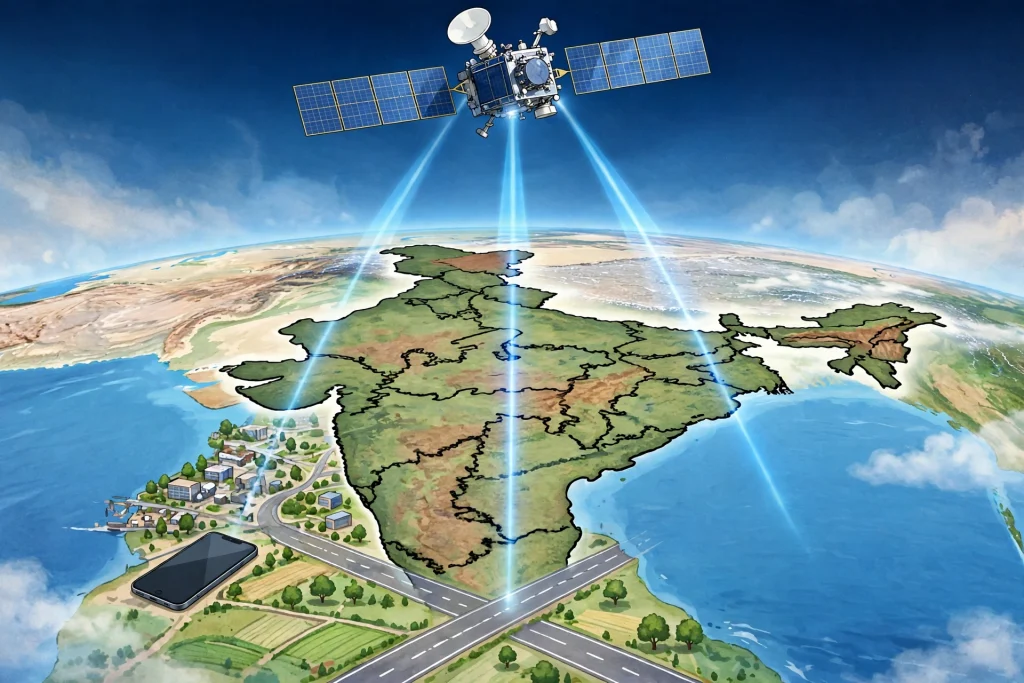
Navigation from space works by triangulation. A receiver on the ground needs signals from at least four satellites at once to fix its position reliably. That simple rule is why NVS-03 matters. In a written reply to Parliament on 29 July 2026, Space Minister Jitendra Singh disclosed that only three NavIC satellites were then providing navigation services, while at least four are required for basic positioning. Timing services remained functional, but the system could not offer standalone positioning on three satellites alone. Adding NVS-03 takes the positioning fleet to the four satellite minimum. It does not complete the constellation, and it does not turn NavIC into a global system overnight, but it restores the basic number the system needs to do its core job. Five second generation navigation satellites have been envisaged to augment the existing constellation and ensure continuity of services, so NVS-03 is one step in a longer programme, not the final step.
What Is NavIC, in Simple Words
NavIC stands for Navigation with Indian Constellation. It is the public name for the Indian Regional Navigation Satellite System (IRNSS), India’s independent regional satellite navigation system. It provides accurate Position, Velocity and Timing services, known as PVT, to users in India and in a region extending about 1,500 km beyond India’s landmass. In everyday terms, that means location for transport and logistics, timing for banks, power grids and telecom networks, marine navigation, disaster alerts, and an encrypted Restricted Service for authorised users, alongside an open service for all users. NavIC exists so that India does not depend entirely on foreign navigation systems such as GPS for services that matter to the economy and to national security. Most phones today use several navigation systems together, and that will remain true after NVS-03. The honest way to describe NavIC is as India’s own regional pillar in that mix, not as a replacement for every other system in your phone.
GSLV-F18 and the Journey to Orbit
GSLV-F18 is a three stage rocket, about 50 metres tall, with a lift-off mass of about 420 tonnes. It will not place NVS-03 straight into its working orbit. Instead, it will drop the satellite into a Geosynchronous Transfer Orbit (GTO), a stretched loop with a perigee, or lowest point, of 170 km and an apogee, or highest point, of 37,023 km, tilted at 20.75 degrees to the equator. From there, the satellite will perform orbit raising manoeuvres to reach its final geosynchronous slot, reported as 32.5 degrees East. Think of the launch as the first push, and the days after it as a careful climb, with engineers checking the satellite at each stage before it settles into its slot. This is normal for this kind of mission, and it is why a successful lift-off, while worth celebrating, is not the same as a satellite already in navigation service.
The Indigenous Atomic Clock and the L1 Signal
Two features of NVS-03 deserve attention, because they explain why this satellite is more than a like for like replacement. First, it carries an indigenous atomic clock, developed by the Space Applications Centre, alongside procured atomic clocks. Atomic clocks are the heart of satellite navigation: a tiny timing error in space becomes a large position error on the ground, so precise, reliable clocks matter. Placing a third indigenous atomic clock in space, as reports of the mission describe it, also strengthens India’s time sovereignty, meaning its ability to keep accurate time without depending on others. Second, NVS-03 adds the L1 navigation signal, in addition to the existing L5 and S signals. L1 is the signal most widely used by ordinary consumer devices, so adding it should make NavIC easier for phones and other everyday devices to use, and improve availability and accuracy in cities where signals bounce off buildings. Other reports on the mission make the same point in plainer terms: the L1 signal is the part of NVS-03 most likely to reach ordinary users.
What Happened to NVS-02, and What Changed for NVS-03
Readers following ISRO will remember that the previous satellite in this series, NVS-02, ran into trouble in 2025. An ISRO review published on 25 February 2026 identified a disconnected connector in the drive signal to an oxidizer line pyro valve as the most likely cause, affecting both the primary and redundant paths. For NVS-03, ISRO has taken a visible precaution: the satellite will fly with its pyro valves already open, a first for the agency, according to reports of the mission. That detail matters because it shows how a failure review feeds directly into the next flight. It does not guarantee success, and no honest guide should promise it. Spaceflight always carries risk, and the countdown, the transfer orbit and the orbit raising phase each have to go right. What can be said is that ISRO has publicly named the earlier problem and changed the approach for this flight.
What NVS-03 Does Not Change Yet
It is easy to overclaim a single launch, so here is what NVS-03 does not do. It does not expand NavIC’s coverage beyond India and about 1,500 km around it. It does not, on its own, complete the constellation: even with NVS-03 in service, further second generation satellites are planned to build depth and resilience. It does not announce a new positioning accuracy figure, and ISRO’s mission page does not promise expanded coverage or improved accuracy as the stated purpose: the stated purpose is to maintain and augment navigation services. And it does not mean your phone will suddenly show “NavIC only” or stop using other systems. The realistic benefit is steadier, more usable Indian navigation coverage, better device compatibility through L1, and a constellation back above its minimum working number. That is a real gain, and it is enough without exaggeration.

How to Watch the Launch Safely
If you want to watch, use ISRO’s own channels. ISRO said its live webcast would begin at 11:20 pm IST on 30 October, ahead of the 11:51 pm IST lift-off. Watch on ISRO’s official website or official social media accounts, and be wary of unofficial “live” videos that reuse old launch footage, add fake countdown timers, or ask you to click links, download apps or pay for access. A genuine launch stream will not ask for payment, a one time password, or your bank details. If a video claims the launch has already happened hours before the scheduled time, or shows a daytime launch for a night mission, treat it as reused footage. After lift-off, follow ISRO’s own updates for confirmation of orbit insertion, rather than relying on forwarded clips.
What Happens Next After NVS-03
After the GTO insertion and orbit raising, engineers will test the satellite’s systems, including its clocks and signals, before it is declared ready for navigation service. The next second generation satellites, NVS-04 and NVS-05, are described in mission coverage as advancing toward readiness, and their progress will decide how quickly NavIC moves from meeting the minimum to having real depth. For users, the change will be gradual and mostly invisible: better availability in difficult locations, more devices able to use NavIC signals, and a more resilient Indian timing and navigation backbone. For India, the strategic point is continuity. Navigation and timing now sit underneath banking, telecom, transport, power and disaster response, and a system that cannot maintain its minimum satellite count cannot be relied on for those jobs. NVS-03 is, above all, a continuity mission, and that is why ISRO scheduled it when it did.
Frequently Asked Questions
When is the ISRO NVS-03 launch?
The GSLV-F18/NVS-03 mission is scheduled for 11:51 pm IST on 30 October 2026, from the Satish Dhawan Space Centre in Sriharikota. ISRO’s live webcast was scheduled to begin at 11:20 pm IST.
What is NVS-03?
NVS-03 is the third satellite in India’s second generation NavIC series. It is a navigation satellite designed to augment the NavIC constellation and ensure continuity of navigation services over India and about 1,500 km beyond it.
What is NavIC?
NavIC, or Navigation with Indian Constellation, is India’s independent regional satellite navigation system. It provides Position, Velocity and Timing services, with an open service for all users and an encrypted Restricted Service for authorised users.
Why does NVS-03 matter if only one satellite is launching?
Because navigation needs at least four satellites for basic positioning, and only three NavIC satellites were providing navigation services in July 2026, according to the government’s Parliament reply. NVS-03 restores the four satellite minimum.
What is the L1 signal on NVS-03?
L1 is a navigation signal widely used by ordinary consumer devices. NVS-03 adds L1 to the existing L5 and S signals, which should make NavIC easier for phones and everyday devices to use.
Will my phone use NavIC after NVS-03?
Your phone will most likely continue to use several navigation systems together, as it does today. NVS-03 should improve NavIC availability and device compatibility, especially through the L1 signal, but it does not replace other systems or expand NavIC to global coverage.
Conclusion
The ISRO NVS-03 launch is a quiet but important mission: one satellite, launched at 11:51 pm IST on 30 October 2026 aboard GSLV-F18, that takes NavIC back to the four satellites it needs for basic positioning, adds the consumer friendly L1 signal, and carries an indigenous atomic clock into space. It does not finish the constellation, expand coverage worldwide, or change your phone overnight, and it still has to complete its climb to its final orbit and pass its checks before entering service. Judged honestly, though, it is exactly the kind of mission a navigation system needs most: a continuity launch, informed by the NVS-02 failure review, that keeps India’s own timing and location backbone working. For readers who follow space and technology, our guides to the biggest science discoveries and research shaping the year, major technology conferences to watch in 2026 and breaking technology news and the stories shaping it are good places to continue.

3 Comments
Pingback: New Rules From 1 November 2026 in India: CNAP, FASTag, LPG and GST Changes
Pingback: India 500 GW Renewable Energy Plan: Summit 2026, Targets and Investment
Pingback: Agniveer 2 Year Extension: Second Tour of Duty, Pay and Regular Service Path